Creating care projects is in B2Ai’s DNA. Each project is an actualisation with more expertise, based on the advancing insights of experience we’ve gained.
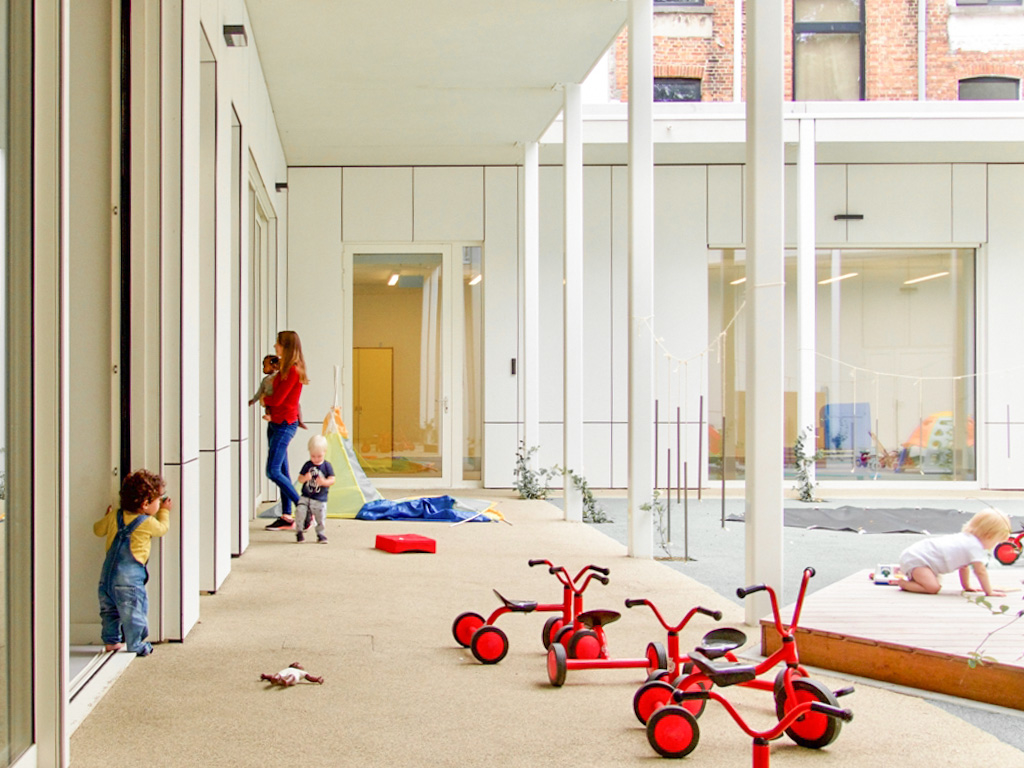
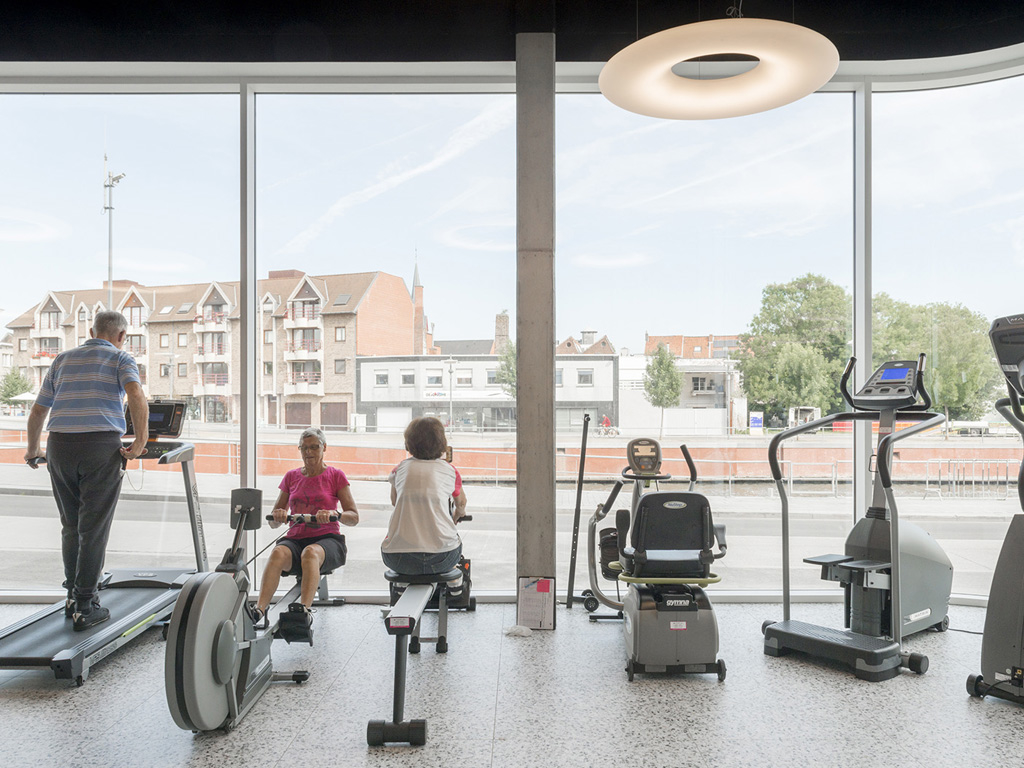
As an architect and partner at B2Ai, Julie Vermoortel works in the healthcare sector and he does so from a broad vision. “Care is quickly connected to care for the elderly and residential care centres. However, quality care is needed at every stage of life, from birth through school to adulthood, with a specific focus on (young) adults with mental or physical problems. I also consider difficult home situations, for example because of rehabilitation, to be care projects because architecture can offer a tailor-made solution. And then, of course, to ultimately arrive at care of the elderly, but not to limit ourselves to residential care homes or hospitals.”
An important theme for B2Ai is ‘invisible care’, a non-traditional approach to healthcare. This means healthcare is no longer separated from, but integrated in society. This doesn’t necessarily need to result in small scale solutions, we are not blind to the economic and practical side of the industry. Invisible care is about integrating into the spatial and social environment and opening up to the surroundings. The architectural design is of great importance: the layout of the rooms – not in a classical nursing home/hallway pattern, the introduction of homeliness,… This expertise comes in handy in mixed-use projects where daycare or senior care are integrated.
“Designing for care is not possible without a thorough knowledge of the regulations,” says Wim Van Cromphout. “They’re very specific in the healthcare world. The care of the residents, the implementation of the recognitions, the regulation of the subsidy and the fees, the aspect of food and kitchen design, etc. As a result of, among other things, the evolution towards the users’ personal budgets, the regulations in the sector are in any case subject to a great deal of change and need to be closely monitored. Although I’m still interested in the general design trends in education and office construction.”
Over the past twenty years, B2Ai has built up expertise in the legal and technical world of healthcare. To never lose sight of the deeply human aspect. Our designers find it important to fully empathise with the users. Wim Van Cromphout explains, “We always ask ourselves the question: what if I myself were to end up in this situation? You have your own grandparents who need care, small children. You automatically come into contact with care providers and care infrastructures yourself, as a private individual.
We use our own human experience in combination with our more technical knowledge of the sector as a reality check for our clients and our clients’ clients. The latter group is just as important, whether it’s the resident or the patient, the staff or the visitor.”
We owe the broad insights into what technical, design-based, and human care can be to the diversity of our portfolio. Each project has been developed specifically for the site. Cross-generational neighbourhood models such as Triamant require a different expertise in terms of design than projects for Heilig Hart, Zorg-Saam Kindsheid Jesu, Sint-Jozef, or PCSWs. A hospital like AZ Zeno is a lot more technical. “Each project starts with a very precise project definition that responds to the questions, but also to the social trends. These include things developing strategies for breaking down cultural barriers in the care sector, the diversification of the care range, and the mixing of functions. The correct composition of a team – internal or external – enables us to optimally complete a project. We have in-house specialists for project definition, Building Information Modelling (BIM), yield monitoring, legal assistance, guidance on permit processes, tendering procedures, contract management, and quality control. Usually, we are asked to do a lot more than just fill in the space.”